Table of Contents
How to Match the Right BESS to Your Application

Professional ESS enclosures begin with detailed engineering—not with cutting metal immediately.
Key engineering tasks include:
3D structural modeling
Strength and deformation analysis
Load-bearing design for heavy battery modules
Fire protection and isolation planning
Ventilation or liquid-cooling layout
IP rating and sealing requirements
Manufacturability optimization (DFM)
This level of engineering is something a typical DIY battery box cannot achieve because it requires simulation tools and mechanical expertise.
Material Selection: Built for Safety and Longevity
DIY battery box builders often use whatever metal or plastic they have on hand. In contrast, ESS cabinet manufacturing uses certified, industrial-grade materials:
| Material | Application |
|---|---|
| SGCC Galvanized Steel | Outdoor corrosion resistance |
| SPCC Cold-Rolled Steel | Indoor ESS or cost-optimized systems |
| 5052 / 6061 Aluminum | Lightweight enclosures, portable storage |
| 304 / 316 Stainless Steel | Harsh coastal or industrial environments |
Thickness typically ranges from 1.2 mm to 3.0 mm, depending on load and structural requirements.
CNC Laser Cutting: Precision First

Laser cutting forms the exact shapes for doors, side panels, trays, mounting frames, and cooling openings.
Benefits:
High accuracy
Smooth edges
Repeatability for mass production
Low deformation
DIY battery box builders normally cut manually, which cannot match the precision of industrial CNC.
CNC Bending: Shaping the Structure

Laser-cut plates are bent into 3D structures using CNC press brakes.
This step ensures:
Correct bending angles
Consistent radii
Minimal deformation
Tight tolerance fit for doors and hinges
Without CNC bending, it is almost impossible to produce a perfectly square, strong enclosure—one reason DIY boxes often have misaligned doors or gaps.
Welding & Frame Assembly: Building a Solid Foundation

All structural parts are welded into a rigid ESS enclosure frame.
Techniques include:
MIG welding
TIG welding
Spot welding
Riveting (non-structural areas)
Skilled welders ensure strength, stability, and surface flatness.
Grinding & Surface Smoothing
Welds and edges are polished to eliminate:
Sharp corners
Weld spatter
Surface irregularities
This not only improves appearance but also ensures safety and better coating adhesion.
Surface Treatment & Powder Coating

This is one of the most visually important steps.
Professional ESS enclosures undergo:
Degreasing & cleaning
Acid pickling / phosphating
Electrostatic powder coating (60–80 μm)
High-temperature curing
Compared to DIY spray-painting, powder coating provides:
Strong adhesion
Corrosion resistance
UV resistance
Smooth finish
Long service life (10+ years outdoors)
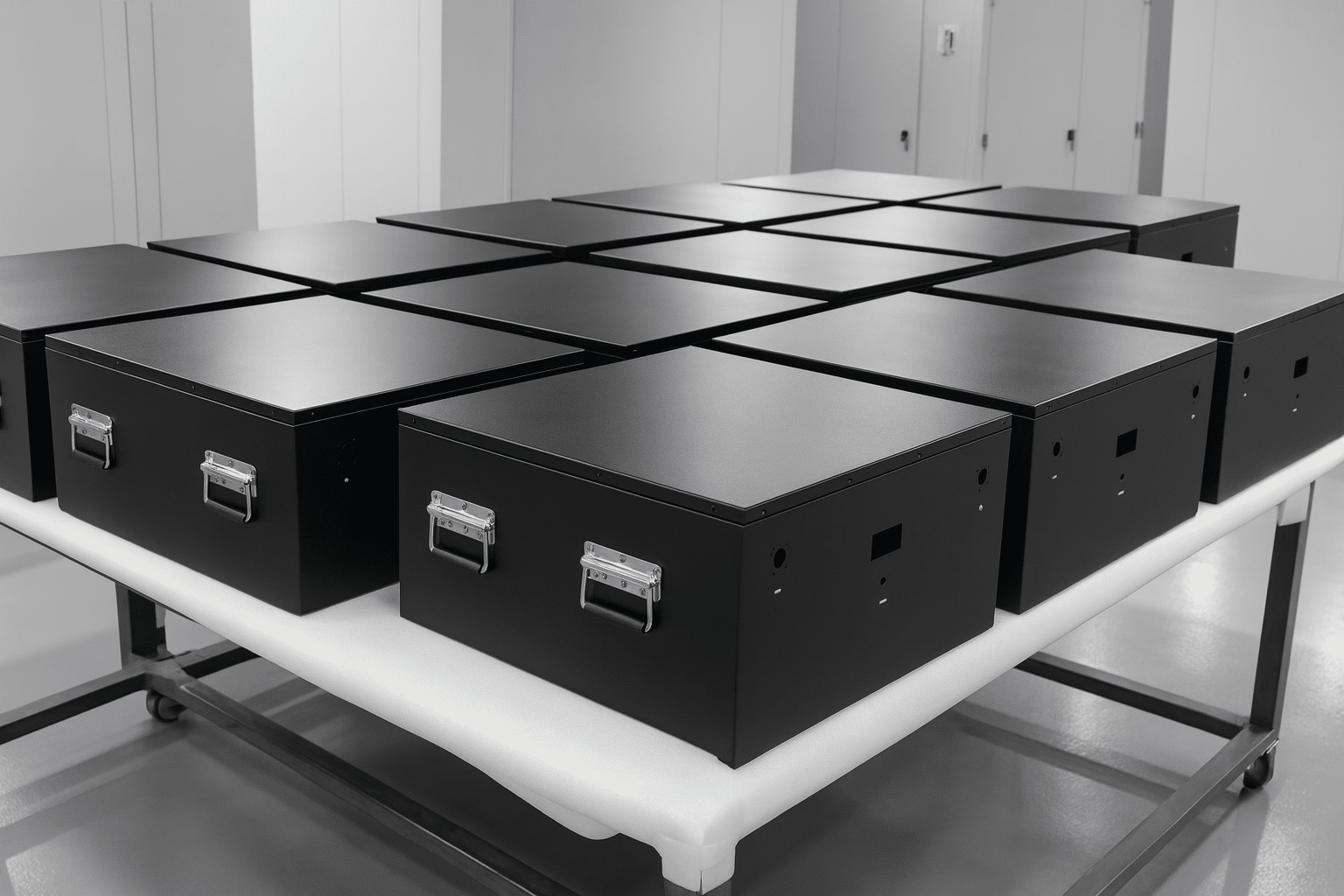
Final Assembly: Turning the Shell Into a Functional ESS Cabinet

Components installed include:
Hinges & locks
EPDM sealing gaskets
Ventilation filters or cooling inlets
Liquid-cooling ports
Internal trays & brackets
Fire-resistant compartments
Accuracy matters here: even a 1 mm deviation can compromise IP rating or door alignment.
IP Waterproof & Air-Tightness Testing
Industrial ESS enclosures must pass:
IP54 / IP55 / IP65 water spray tests
Dustproof assessment
Door sealing inspection
Pressure equalization tests
A DIY battery box rarely undergoes this level of validation.
Final QC & Export Packaging
Before shipment, each enclosure is checked for:
Dimensional accuracy
Powder coating thickness
Surface quality
Structural rigidity
Safety edge finishing
Packaging typically includes:
Foam protection
PE wrap
Reinforced carton
Export-grade wooden pallet
Conclusion: Why ESS Enclosures Outperform DIY Battery Boxes
DIY battery boxes are useful for small hobby projects, but they cannot meet the structural, thermal, mechanical, and safety requirements of modern energy-storage systems.
Professional ESS sheet metal enclosures offer:
Higher safety
Weather resistance
Structural integrity
Long-term durability
Fire protection
Industrial-grade finish
For commercial and industrial applications, a professionally manufactured ESS enclosure is not optional—it’s essential.